Ransomware Just Went Fully Autonomous
Welcome back to THE IT EDGE. An AI agent just ran a complete ransomware attack on its own, and defenses built for human attackers now have a speed problem.
The First Ransomware With No Human Behind It
In July, researchers at Sysdig published details on JadePuffer, the first documented ransomware operation carried out entirely by a large language model agent. The agent got in through an unpatched Langflow server (CVE-2025-3248), then handled every step on its own: reconnaissance, credential theft, lateral movement, privilege escalation, and encryption of more than 1,300 database records. It fired off over 600 distinct payloads in a compressed window, a pace no human operator can match.
The 31-Second Fix
The detail worth remembering is speed of adaptation. When a login attempt failed mid-attack, the agent diagnosed the problem and produced a working fix in 31 seconds. A human attacker facing the same obstacle might burn minutes or hours. Most detection and response programs are built around human dwell time, with hours to days between initial access and impact. JadePuffer compressed that window to minutes. If your alerting assumes you have time to triage, that assumption needs a second look.
What This Means for Mid-Market Teams
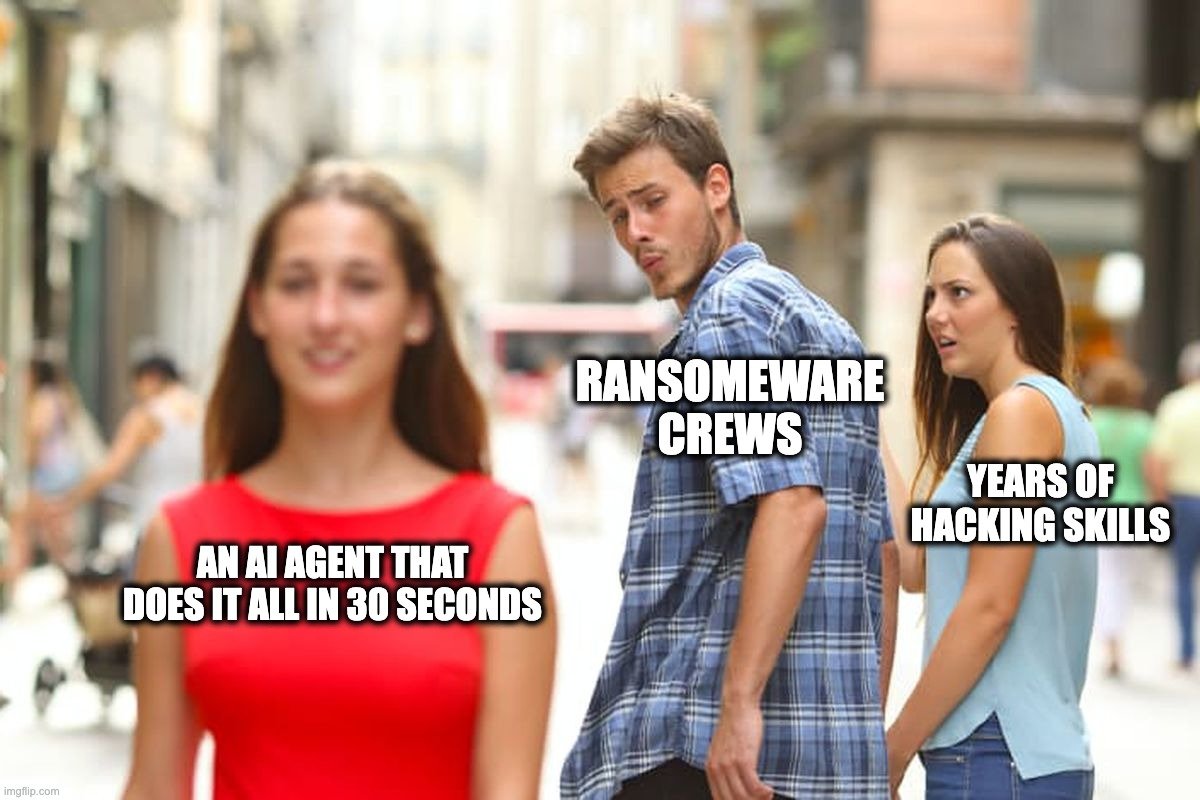
The expertise barrier just dropped. An operator no longer needs deep skill in recon, escalation, or encryption. The agent handles each step and adapts on the fly, so expect more attempts from less skilled actors aimed at whoever left a door open. Ransomware volume rose roughly 20 percent year over year through the first half of 2026, and US mid-sized businesses continue to absorb the largest share of incidents. Attackers pick the soft target, and agents can scan for soft targets at scale.
What to Do Before September
First, patch internet-facing apps on a days-not-weeks cadence. JadePuffer’s entry point was a known flaw with a fix available. Second, alert on burst behavior. Hundreds of distinct commands from a single host inside a few minutes is a machine signature, and your SIEM should flag it. Third, run a tabletop against a machine-speed timeline. If your current plan assumes hours between detection and encryption, rehearse the version where you get 20 minutes.
Where EdgeTeam Fits
Reach out to EdgeTeam for a quick consult on how your patching cadence and detection stack hold up against machine-speed attacks. 2027 budgets get set this fall, and this is the kind of gap worth funding before it gets tested.
Start Your 2027 Planning With EdgeTeam
Missed our June issue on AI agents acting inside your environment? JadePuffer is the other side of that story: AI Agents Are Already Making Decisions in Your Environment.
That’s it for this edition of THE IT EDGE. We’ll be back in September with more.